Showing posts with label philosophy for children. Show all posts

Why?

Posted in Labels: ,

The picture book Why, written by Lindsay Camp and illustrated by Tony Ross, is one of those books that illuminates in many ways the whole point of doing philosophy with children. The story is about Lily, who, in response to virtually anything that happens, asks the question, "Why?" Her dad tries to respond to her questioning, but sometimes, "when he was a bit tired or too busy," he'd say only, "It just does, Lily. It just does."

One day a giant spaceship lands and the aliens that emerge from the ship announce that their mission is to destroy the planet. Terrified, no one responds, except Lily, who asks, of course, "Why?" After a series of "why" questions, the aliens realize that they don't know why, and they leave.

Can questions save the planet? Asking "why" all the time can be really irritating, but not asking it can be dangerous.

Happy holidays!

Music or food?

Posted in Labels: , ,

Last week fourth grade students at John Muir Elementary and I talked about the story Frederick by Leo Lionni. (I have written about this story in a previous post.) We began talking about why it's important to Frederick to collect words and colors, as opposed to foraging for the food the family will need for the winter. What is important to Frederick about poetry?

One student suggested that to Frederick, "poems are like keys to the universe." "Maybe," the student reflected, "Frederick thinks that he wouldn't survive without poems, the same way his family is worried they won't survive without food."

Several students wanted to know why Frederick couldn't gather food as well as work on his poems, and most wanted to say that if Frederick didn't help collect food he wasn't entitled to an equal share of the food. Others disagreed.

"Okay," I said. "Let's say you were on a desert island with a couple of family members, and you were really worried about having enough food to make it through the winter. All of you went about looking for and storing food, except one of your cousins, who was working on a story that she would be able to tell you when you were holed up for the winter. Would that be okay with you?"

"No," one student said, "because food makes me happier than a story."

"I'd say fine," responded another student. "But she wouldn't be entitled to any of the food."

Most students seemed to agree with this.

"What if your cousin was J.K. Rowling, and was writing a new Harry Potter story?" I asked. "Would that make a difference?"

Many of the students contended that then the contribution of writing a story would be more valuable and perhaps as valuable a contribution as collecting food, although, as one student put it, "You wouldn't know for sure that the story was going to be good, in the way you would know that the food would be."

We discussed the way in which Frederick’s poetry helps the family when they are cold and hungry. I asked the students whether they read much poetry, and most of them said they never did. I told them that I guessed they all knew a lot of poetry, and asked them to recite some of their favorite song lyrics. There were of course immediate responses from many of the students, reciting lyric after lyric. We then talked about what music meant to them and why they liked it. Was it as important as food?

This led to a robust conversation about what you would choose if you had to give up either music or food (but not water) for a couple of days. The students were quite divided about what they could more easily do without, and we talked about the different ways we are nourished in our lives. Are emotional, aesthetic and intellectual forms of nourishment as important as physical nourishment?

Fourth Graders and the Story Double Trouble

Posted in Labels: , , , ,

I had an interesting experience recently with the fourth grade students I'm teaching this year at John Muir Elementary.  I read them the story "Double Trouble" by Philip Cam. A kind of retelling of the "Ship of Theseus," the story is about a robot whose parts have been replaced, one after another, until he no longer has any of his original parts, and a new robot has been built using all of the old parts.  Which one is the "real" Algernon (the robot's name)?

I have used this story for years and it has virtually always inspired a discussion about the standard questions of personal identity and persistence over time.  (I wrote about such a conversation last year in this post.)  In this session, however, the students took the discussion in an entirely different direction.  They voted to start with one of their questions about whether in this story robots were only owned by rich people or whether everyone had robots.  This led to the question about whether robots were things, and a couple of students asserted that robots (or at least the ones in the story) were people.  How do we know what makes someone a person?  The students suggested that having names, or being able to talk and move independently, were possible criteria.  Then several students noted that while the robots seemed to have feelings, they were probably programmed to have them, and that this is what made them different from people.

Several of my undergraduate students were present that day, and one commented, "Sometimes I feel things I would like to choose not to feel, but I feel them anyway. Is it possible that I'm programmed?"

One of the most interesting features of the conversation that ensued in that fourth grade classroom was how closely it resembled a similar conversation I had with college students not too long ago.  The students went from being sure they were not programmed to speculating about the possibility that, as one child put it, "there are beings out there somewhere who are a lot bigger than us and they are totally controlling what we do."

"That could be," another student responded. "But at the same time, I feel like what goes on inside me is really me, that it can't be controlled by anyone else. Maybe someone could be controlling what I do, but I don't think they could be controlling what I feel."

The discussion went on for over an hour and at the end we talked about how complex these questions were, and how sometimes in philosophy the questions seemed even more puzzling after talking about them than they had originally.

The Lorax

Posted in Labels: , , ,

This morning I talked about Dr. Suess' The Lorax with a class of fourth grade students at John Stanford International School in Seattle. They have been having discussions about environmental issues, and we had a lovely conversation about the destruction of the truffula trees and the loss of Bar-ba-loots, Swomee-Swans and Humming-Fish in the story.

We began by talking about the Once-ler and his decision to chop down truffula trees and build a business of selling thneeds made from truffula tree tufts. Was he responsible for the environmental destruction that ensued as a result of his decisions? Does the fact that he ultimately regrets his actions make him a better person? We talked about the other members of the Once-ler family who worked in the business, and about all the people who bought thneeds. Were they all responsible for the destruction of the truffula trees and surrounding habitat? When we purchase something, are we obligated to ask how it was made? Were the thneeds "useful?" What is the balance between creating things that make human life easier or more enjoyable, and caring for the environment in which we live? What is our responsibility to the environment and to other species affected by human decisions?

Harold and the Purple Crayon

Posted in Labels: , , ,

What can we know about the nature of reality? A wonderful story for motivating conversations about this question is Harold and the Purple Crayon by Crockett Johnson. First published in 1955, the story begins with Harold deciding, “after thinking it over for some time,” to take a walk in the moonlight. No moon is out, so Harold takes his purple crayon and draws one, and then he draws something to walk on.  Harold goes on to draw a forest in which he wanders, a dragon that ends up frightening him, an ocean in which he almost drowns and a boat which saves him, a beach, a lunch to eat, etc.

This story was a favorite of my children when they were younger, and I have read it with children in classrooms from first grade through middle school. It raises such questions as: Is Harold pretending? Is what he draws real? How can what he draws scare him? Is the moon we see more real than Harold’s moon – and, if so, why? Is Harold dreaming? Can we create our own reality?

Seeing ish-ly: what makes someone an artist?

Posted in Labels: , , ,

Peter Reynolds' picture book ish tells the story of Ramon, who loves to draw and draws all the time. Then one day his older brother laughs at one of his drawings, and Ramon becomes preoccupied with making his drawings "look right." Finally he decides to stop drawing. His younger sister picks up one of his crumpled drawings and Ramon follows her into her room to retrieve it, where he sees many of his crumpled-up drawings hanging on her walls. She points out a drawing of a vase of flowers, which she declares is one of her favorites. Ramon tells her that the drawing was supposed to be a vase of flowers but he doesn't think it looks like one. "It looks vase-ISH!" she replies.

Looking at the world "ish-ly" opens up for Ramon his own way of seeing and gives him confidence that he can express what he feels and perceives, even if the finished products don't conform to a conventional view of the way things are supposed to look.

What makes someone an artist? How do we judge what is a work of art? What is creativity? Where does artistic expression come from? Is art worth creating even if it is not judged to be very good? I think this book can be used with students from elementary school on to ponder these questions. I'm going to try it this fall with fourth grade students as well as college undergraduates.

The Rainbow Fish

Posted in Labels: , , , ,

The Rainbow Fish by Marcus Pfister is a picture book that parents seem either to love or to hate. It is the story of a fish, described as "the most beautiful fish in the entire ocean," with rainbow-colored, iridescent scales. The other fish call him "Rainbow Fish," and invite him to play with them, but he remains uninterested and aloof. A small blue fish follows him one day, asking for one of his scales, and is rebuffed. The rainbow fish ends up ostracized by all the other fish, and his scales begin to mean less to him with "no one to admire them." Taking the advice of an octopus whose suggestions he seeks, the rainbow fish gives all his scales away, one by one, until he is left with only one. Surrounded by many fish, each with one iridescent scale, the rainbow fish now no longer looked different, and he "at last felt at home among the other fish."

The story raises questions about being different versus one of the crowd, identity and self-worth, selfishness and generosity, the nature of beauty, and the meaning of friendship. Some people read it as promoting the message that we all should be the same, others as advocating for recognition of the value of inner beauty and generosity. To my mind, the story can be read as endorsing several contradictory ideas, which makes it quite philosophically interesting. I have found that it's very appealing to children, and easily sparks conversations about independence and conformity, being unique versus fitting in, and what friendship requires.

Wilfrid Gordon McDonald Partridge

Posted in Labels: , , ,

Mem Fox's picture book Wilfrid Gordon McDonald Partridge is the story of a young boy, Wilfrid Gordon, whose "house was next door to an old people's home and [who] knew all the people who lived there." His favorite person at the home is Miss Nancy, and Wilfrid Gordon's father tells him that, at 96, she has lost her memory.

Wilfrid Gordon sets out to understand what memory is and asks several of the people in the home about it. He then collects some of his things that bring back his own memories and gives them to Miss Nancy, who begins then to recollect some of her own memories.

The story is a lovely one, with appealing, colorful illustrations, and it raises such issues as: What is memory? Are we still ourselves if we lose our memories? Can you lose a memory and then find it again? Can we rely on our memories to give us accurate accounts of the past? What is the role of relationships in memory?

What is most important in life?

Posted in Labels: , ,

On Thursday I read a chapter of E.B. White's Stuart Littlewith the 4th grade students at John Muir Elementary. The chapter describes Stuart's one-day experience acting as a substitute teacher. One of the first things Stuart asks his students is whether they know what's important. The students in the story give various responses, including "a shaft of sunlight at the end of a dark afternoon, a note in music, and the way the back of a baby's neck smells if its mother keeps it tidy."

After the reading, I asked the John Muir students to write down five things in their lives that they thought were the most important. We put about 30 of them up on the board, and many of the students' choices seemed to me close to what most people would say, pointing to what we think of as fundamental aspects of life - family, friends, food, health. Their responses also included things like playing video games, seasons, dance, sports, reading, etc. I then asked them what would remain on the list if they knew they only had a month left to live. The students thought seriously about this question and we pared the list down to much fewer items, including family, friends, food, medicine, and dance.

We then talked about what made these things important. The students mentioned having fun, being happy, and receiving comfort as the basis for what is important to them. One student then said that she would spend a lot of time planning her funeral and writing out invitations to the people in her life, because it would matter to her to spend her time doing something that felt productive. Another student commented that she would spend her last days reflecting about her life, thinking about the mistakes she'd made and the positive things she'd done, and kind of making sense of her life for herself. A third student agreed, remarking that he would take these reflections and put them in a journal and put them outside his door for his family to find, lock the door "and then die in a way that would feel peaceful." Several students agreed with this and talked about how important it would be to them to say goodbye to the people they loved and to have their lives feel as if they'd had some purpose. We discussed whether what is important to you changes as you age and get closer to death, and whether death is in some respects the defining feature of life.

I thought about this conversation after it ended. Many of the reflections offered by the children were the kinds of things people often assume ten-year-old children aren't thinking about and/or capable of contemplating. There was a thoughtfulness and seriousness to our conversation that reminded me of how vibrant philosophical thinking can be in children and how important it is to nurture that part of them.

The experience of childhood

Posted in Labels: , , , ,

Last week I had a conversation with fourth grade students at John Muir Elementary about the story Albert's Toothache by Barbara Williams, one of my favorite picture books. In the story, Albert, a turtle, complains that he has a toothache. His family points out that he has no teeth, and so he cannot have a toothache. "You never believe me," Albert protests, and he takes to his bed. His parents and siblings lament that Albert is not telling the truth. Finally, his grandmother arrives, and asks Albert, "Where is your toothache?" Albert tells her that it is in his toe, where a gopher bit him.

I read the story to the students and then, as is our practice, we took a minute to reflect before the students articulated the questions the story raised for them. They chose to begin our discussion with the question, "Why did Albert say he had a toothache when the pain was in his foot?"

The students commented that perhaps Albert was confused or misunderstood what a tooth is. One student suggested that what Albert might have meant was that his pain came from the gopher's tooth, so that's why he called it a toothache.

We moved from that question to another student's question, "Why didn't Albert's family believe him, and why was his grandmother the only one who tried to figure out what he meant?" The students observed that the family seemed to have a "story about Albert," in which Albert was the family member who often made things up. One student remarked that often children aren't believed.

"Do you think the family would have reacted differently if it was Albert's mom who was complaining of a toothache?" I asked. Unanimously, the class said yes, it would have been a completely different situation. "Why is that?" I inquired.

"Adults are believed when kids aren't," one student asserted. "People think adults are more trustworthy than kids."

"Are they?" I asked.

"Not always," responded another student. "Adults sometimes lie about things. Like when children are being abused. Adults will lie about it to protect themselves, and often people believe the adults instead of the kids."

"I think," put in a student, "that people think of kids as becoming adults, and so they expect kids to make all kinds of mistakes that they don't think adults will make."

"So is childhood an experience about becoming an adult, or is there more to it than that?" I asked.

"I think," ventured a student who had not yet spoken, "that children are deeper than adults."

"What do you mean?"

"I mean that childhood is not just about becoming an adult. It's a time of its own. What happens to kids affects us our whole lives. That's mostly not true for adults. I think what we experience we feel more deeply, and it stays with us."

PLATO and a national movement for philosophy in the schools

Posted in Labels: ,

For most of the 15 years that I've been involved in this field, there have been an isolated few of us around the country working to introduce philosophy to pre-college students. But in the last few years, over a dozen new pre-college philosophy programs have begun, and I now hear regularly about additional new efforts taking place. Many of these projects have been initiated by philosophy graduate students, just as we founders of the Northwest Center for Philosophy for Children started it as grad students in 1996. My hope is that this groundswell of support for bringing philosophy into the lives of young people will result in more and more children and teenagers around the US having access to philosophical thinking and discussions.


This growing movement inspired a group of us to start PLATO (Philosophy Learning and Teaching Organization), a national organization affiliated with the American Philosophical Association. PLATO will advocate for pre-college philosophy and provide a point of connection for the education and philosophy communities. We are in the process of developing a more detailed vision and structure for PLATO.


Our inaugural event, the first PLATO Institute, will take place at Columbia University this June. Over 25 speakers from more than 15 colleges and universities will be speaking about both conceptual and practical issues involved in teaching pre-college philosophy. The institute will be organized as a community of philosophical inquiry, in which the focus will be on constructing an ongoing dialogue among the participants. I expect it will be a really energizing and meaningful two days!

Moral Relativism or Mutual Respect?

Posted in Labels: ,

I had a lively conversation yesterday with a group of fifth graders about how we can understand, respect and evaluate cultures other than our own. The conversation took off when one student asked, "Why do we have so many different cultures in the world?" The students pointed out the ways in which the diversity of cultures gives rise to conflicts, but also observed that a world without a variety of cultures would be pretty uninteresting.

One student then asserted that we aren't really justified in making judgments about cultures other than our own, because we're not understanding them "from the inside" and so are evaluating their practices without really understanding why the people in that culture are doing what they do. This led to a thoughtful dialogue among the students about when, and if ever, people or groups outside of a culture are justified in criticizing, or intervening in, a cultural practice.

We talked about the different standards for disciplining children around the world. Several students articulated a distinction between coming to another country and practicing, for example, a form of corporal punishment unacceptable here, and doing so in your own country. The students tended to claim that it is one thing to insist that someone from another culture change their practice when they enter a different culture (or country), but that it is another thing to criticize the way people are disciplining their children when they are acting on the basis of a different set of rules and standards within that culture.

Still, some students argued, the way the harsh discipline feels to the children is the same. And can't cultures be mistaken? We talked about the fact that in the US, for example, slavery was an acceptable part of the culture for a long period of time, and we would now want to say that this was wrong, that the institutions that supported that practice were in error. And if it's true that cultures can make mistakes in sanctioning acts that ultimately the culture concludes were wrong, how do we decide when intervention is appropriate?

Several students raised the example of the Nazi regime, asserting that there intervention to stop what the German culture was allowing would have been justified. One student suggested that perhaps the standard should be whether human beings were being harmed in serious ways, and we noted that this standard also led to interpretation problems (What constitutes harm? When is it serious? etc.). We discussed the practice of young people marrying at young ages, 12 or 13, in some cultures, a practice that clearly horrified the children. Yet, we pointed out, inside those cultures, that is an accepted and perhaps welcome practice.

How do we know what it feels like from the inside? Can we? And if we can't, does that mean we never are justified in judging or intervening to stop a cultural practice that seems deeply at odds with the ways our culture believes people should be treated? Are there some moral rules that apply to everyone, no matter where and how they live? The students saw clearly what challenging issues these questions raise.

The Dragon who liked to spit Fire

Posted in Labels: , , , ,

This delightful picture book by Judy Varga, written in 1961, tells the story of Darius, a little dragon, and the friendship he develops with young prince Frederic. Can Darius be himself, a dragon who likes nothing more than to spit fire (in many colors), and still be friends with Frederic?

Darius decides to move to Frederic's castle with Frederic. Darius makes this choice because he has been lonely and he wants to be close to Frederic, although he is wary that he will not be able to spit fire at the castle. As Darius tells Frederic, "[L]ife without spitting fire wouldn't be much of a life for a dragon." Frederic tells Darius that he will be able to spit fire when they are alone. Darius is made to feel very at home in the castle, but he finds that he can't ever spit fire, because he and Frederic are never alone.

The story, with its marvelous illustrations, makes me think about friendship, and whether compromises are essential to human relationships. If so, are there compromises that demand too much of us? How would we know? Is Darius being asked to give up something that is too important to him for a friendship to require its absence? Is being a dragon essential to Darius' identity, and is spitting fire necessary for his well-being? I am putting this one on my list to try out with my fourth grade students!

Frindle

Posted in Labels: , , ,

The young adult novel Frindle by Andrew Clements is the story of a clever fifth grade student, Nick Allen, who decides to invent a new word, and the consequences of what he does and the way he does it. It is a wonderful, engaging novel that captivated all three of my sons in elementary school. The story touches on many philosophical issues, including the nature of language, the meaning of words, the social and political justifications for educating young people, and the nature of creativity. It's a perfect story to read aloud to your children or to a class, or to read along with your reader child(ren), and discuss along the way. An illustrative passage, in which Nick's teacher is speaking to him:
" 'Who says dog means dog? You do, Nicholas. You and me and everyone else in this class and this school and this town and this state and this country. We all agree. . . . But if all of us in this room decided to call that creature something else, and if everyone else did, too, then that's what it would be called, and one day it would be written in the dictionary that way. We decide what goes in that book.' And she pointed at the giant dictionary."

The Big Orange Splot

Posted in Labels: , , ,


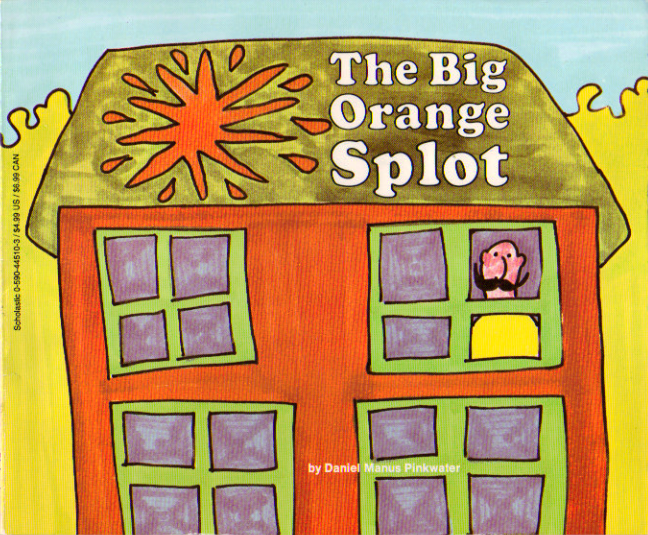
The Big Orange Splot by Daniel Manus Pinkwater is a picture book that tells the story of Mr. Plumbean, who lives on a street where the houses are all the same, painted red with olive-colored roofs and windows with green trim. He and his neighbors all like this, characterizing their street as a "neat street."

One day, a seagull drops a can of bright orange paint on Mr. Plumbean's house, leaving a big orange splot on the house. Everyone on the street sympathizes with Mr. Plumbean, who will have to paint his house again, and that's what Mr. Plumbean plans to do. But, instead, he looks at the house for a long time. Finally, in response to his neighbors' urging, Mr. Plumbean takes out some paint and paints his house. But instead of using the house's original colors, he paints it a rainbow of colors. Over the next couple of days, he adds to his house a clock tower, palm trees, a hammock and an alligator.

Horrified, one by one the neighbors stop in to see Mr. Plumbean to talk with him about their dissatisfaction with what he's done to his home and remind him that all the houses have to be the same for their street to continue to be a "neat street." And, one by one, after each neighbor visits with Mr. Plumbean, sitting under the palm trees, drinking lemonade and talking, each neighbor repaints his or her own house to "fit his dreams."

This is a wonderful story for inspiring conversations about conformity and independence and our obligations to our communities. I talked about this story this fall with my fourth grade students from John Muir Elementary. We had a lively discussion about whether Mr. Plumbean was right to paint his house in a way different from his neighbors, when part of the community agreement was that they would keep their houses looking the same. The students were really curious about what it was that made Mr. Plumbean's decision to paint his house to "fit his dreams" so compelling to his neighbors, so that after spending time with him they all changed their minds about how their street should appear. And what if the neighbors had continued to want all the houses to look the same? The students were strongly supportive of Mr. Plumbean's right to have his house look the way he wanted it to look, even if it offended his neighbors. What if, though, he painted words expressing his hate for an ethnic group? Would that be okay? At what point does his right to make an independent choice give way to his obligations to his neighbors?

The Ugly Duckling

Posted in Labels: , , ,

The classic nineteenth century fairy tale The Ugly Duckling tells the story of a duckling who, when hatched along with his brothers and sisters, is ridiculed and ostracized because they perceive him as ugly. He wanders alone through the fall and winter, and suffers from fear, loneliness, and sadness. In the spring he flies away from the marsh and meets up with a group of swans, and realizes that he too has become a beautiful swan.

The story is familiar to most students and nicely raises philosophical questions about identity and the nature of the self, the meaning of beauty and ugliness, perception, and the experience of solitude. You can read the story with your child or students and ask them questions like whether the "ugly duckling" really was ugly and, if so, what made him ugly? Did he then stop being ugly at the end of the story? What does ugly mean? Would the "ugly duckling" still be ugly if someone thought he was beautiful? How do we decide what is beautiful and what is not? Did the duckling change over the course of the story? Was he still the same duckling? Do our identities change over time? Etc.

Philosophy Talk Show on Pre-College Philosophy

Posted in Labels: ,

You can now listen to the Philosophy Talk radio show on pre-college philosophy, taped at the University of Washington in November: http://depts.washington.edu/nwcenter/resourcestalkradio.html

Philosophy Talk and Fourth Grade Philosophers

Posted in Labels: ,

Recently the fourth grade students at John Muir with whom I've been doing philosophy and I taped a segment for the radio show Philosophy Talk. We talked about personal identity, the mind-body problem, and the nature of happiness.

The students were so impressive! We all had a great time. Here is a recent University of Washington article about the event: http://www.artsci.washington.edu/newsletter/Nov10/PhilosophyTalk.asp

The Cricket in Times Square

Posted in Labels: , , ,


One of my favorite works of children's literature, The Cricket in Times Square by George Selden, first published in 1960, is moving, funny and philosophically suggestive. In particular, the book can inspire discussion about a variety of ethical questions.

The story involves Chester, a cricket, who arrives in Times Square in an accidental way from his country home in Connecticut and is befriended by Mario Bellini, whose family owns a newsstand in the Times Square subway station. Chester's relationship with the Bellini family, his musical talent, his friendships with city-savvy Tucker Mouse and Harry the Cat, and his desire to help others are woven into a story that asks questions about happiness, our obligations to the people in our lives, talent and its cultivation, justice, and fairness.

For example, Chester's musical ability becomes a sensation and brings people to the newsstand, which helps the struggling Bellini family and provides pleasure to all of the people who hear Chester's music around the city. Chester, however, is uncomfortable with his growing fame and misses the rural life he knew in Connecticut. He wants to return there. Tucker Mouse, Harry the Cat and Chester have a conversation about whether this would be the right decision for Chester to make, weighing Chester's happiness and his right to choose the course of his life against the possible negative consequences of this choice (the potentially negative effect on the Bellini newsstand, Mario's sadness when Chester leaves, the loss of the opportunity to listen to Chester's music for thousands of listeners, etc.).

Throughout the story, there are several junctures at which Chester and other characters must make moral decisions -- whether to help someone else, tell the truth, abandon a difficult situation -- and the characters' discussions and reflections can motivate interesting discussions with children about these situations. Charmingly illustrated by Garth Williams, the story, in my experience, is completely engaging for children ages 5 to 12, and captivates older readers and listeners as well.

Double Trouble

Posted in Labels: , , , ,

On Friday the 4th graders at John Muir and I had a long conversation about personal identity. We also had some visitors from Nova High School, as well as one of the graduate students at UW working with us this year.

We read Philip Cam's story, "Double Trouble," about a robot, Algernon, who, one by one, has all of his parts replaced until none of his original parts are left. The robot company creates a new robot using all of the original parts, and a puzzle ensues. Which of the two robots is the real Algernon?

The students had lots of questions about which robot constitutes the real Algernon, and about the ethics of the company's actions. They voted to begin our conversation with the question about whether the "real" Algernon is the robot who has gradually had his parts replaced, or the one who was created from all of the original parts. We had a really spirited discussion about this topic for over an hour, with students raising many issues about what makes the robot that particular robot (thoughts? memories? the same body?) and whether any of us really maintains the same identity over time. I told them the famous "Ship of Theseus" puzzle, and the students were quite divided over whether the ship that had had all of its planks replaced was still Theseus' ship. And if it wasn't, at what point did it cease to be Theseus' ship? When one plank was replaced? Ten planks? Half of the planks? Three-quarters?

Eventually we ended up in a long discussion about whether, if I exchanged brains with one of the students, I would still be "Dr. Jana" or the student would have become Dr. Jana. Most of the students seemed to conclude that the student would have become Dr. Jana and I would have become the student, but several wanted to say that I would not be Dr. Jana or the student, but would become some third identity, with Dr. Jana's body (minus the brain) and the student's brain, because, as one student put it, "you would still have some physical instincts and ways of moving that were really Dr. Jana's and not [the student's]." What is it, then, that makes us the people we are? The students recognized that this is a really difficult and complex question.

It was a fascinating and really animated discussion, with many of the students in the class participating. The question about what makes us who we are and whether we remain that person despite significant changes seems always to inspire a meaningful and thoughtful conversation.