Showing posts with label science. Show all posts

Vernier announces LabQuest2 - Android, iPhone, iPad data collection and analysis

Posted in Labels: , ,


Vernier, the company that makes those really cool data collection probes and sensors and analyzing software, has just announced LabQuest 2 software. As part of their new Connected Science System, LabQuest 2 provides tools for mobile devices such as Android, iPhone and iPad, to collect, analyze, save and share sensor data. The system also allows remote viewing and controlling of LabQuest with a computer and the ability to email data and graphs for later analysis.

This is another example of leveraging the mobile devices that are already in students' hands for educational uses.


LabQuest 2 with iPads iPhones and tablets
They also have two new devices: a Polarimeter (Chemical) and Projectile Launcher.

Vernier products are in use in science classrooms (and some math) to collect, analyze and interpret data from experiments and activities. Their products are similar to what is used in industry, so students learn content and theory and how to use digital tools. 

Teaching Science with Technology - Looking for a dynamic way to teach science? Vernier puts easy-to-use data loggers, sensors, experiments and graphing/analysis software into the hands of students, helping educators develop the next generation of scientists and engineers.

They allow students to spend more time learning the concepts and theory and also allow for better visualization and analysis of data.


Vernier also has resources to help find grants and funding for these products and I've gotten many through DonorsChoose.

Vernier also runs free workshops around the country where they show you how to use their products. You can also get package deals that include manuals and products.


Related:

Vernier Data Collection Sensors and Tools

10 Things Students use technology for in my class (including Vernier)

TI announces the TI-Nspire CX, it's first color-display, handheld graphing calculator - works with Vernier.


NCLB’s Impact on Science Education - NSTA Reports

Posted in Labels: , ,


NSTA, the National Science Teacher's Association, has a great report on the impact of NCLB on Science Education in the US.

The report has data and comments from educators. NCLB does not focus on science in the lower grades. As such, science takes a back seat in the lower grades. Many schools cut back on science education to make more room for reading, writing and math.

At the secondary level, science test prep causes many schools to cut back on labs and activities, instead focusing on test prep and content facts.

Science is important. It is a vital area for mankind. We need to make sure all students have a basic literacy in science to be informed consumers and citizens, and we need more students to go into science and engineering careers. Science and engineering solve the worlds problems. Standardized testing does not. We need to improve science education and make sure science is taught in every grade.

All science teachers, administrators, politicians, heck, everyone, need to read this report.
http://www.nsta.org/publications/news/story.aspx?id=59215


Related:

Experiments and Exploration are vital to science education!

3 Ways to Fix U.S. Science Education


10 Important Skills Students need for the Future


Free Aerospace Simulation App - made by educator

Posted in Labels: , , , , , ,


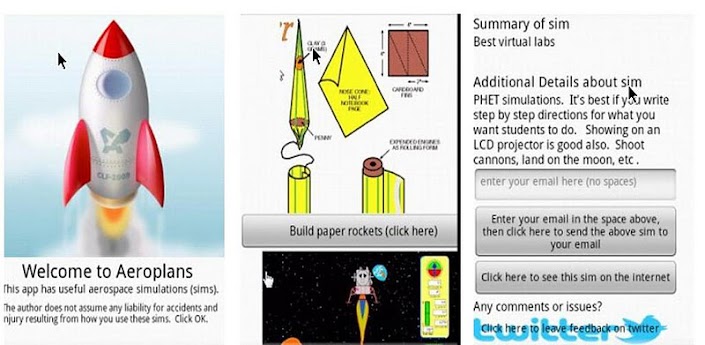
Stephen Hall, and educator and aerospace enthusiast, participated in NASA's Aerospace Professional Development program and then created Aeroplans, a free Android app. The app includes aerospace simulations and instructions for different activities, along with links and information about aerospace topics.

I've been using it for a day or so and it's a fun app and educational.

Aeroplans

Get Aeroplans from the Android Market.


Related:

NASA Simulation based Aerospace Resources for Educators

More great educational resources from NASA

STEM Resources for Educators and Students

Bronx Zoo Teaching Fellowships - great opportunity for students/educators

Posted in Labels: , , ,


The Bronx Zoo (NYC, USA) is a great zoo. They have educational programs in addition to the typical zoo things, and they have teaching fellowships available.

The Teaching Fellowship program is a great opportunity for college students, recent graduates and graduate students to explore conservation education. Fellows learn how to provide a wildlife classroom with student directed learning and conservation issues.

Fellows are paid ($10-$12 per hour) but the learning experience is priceless.

More information can be found at the site: http://bronxzoo.com/educators/teaching-fellows.aspx

There are two Fellowship terms:


School term – starts mid-September and runs through mid-June; fellows must be available to work four weekdays each week, 9:00 a.m.– 2:30 p.m. Additional weekend and overnight hours are also required. School year fellows must have a valid driver’s license.

Summer term – starts mid-June and runs for eleven weeks; fellows must be able to work Monday–Friday, 9:00 a.m.–5:00 p.m. for all eleven weeks. 

To apply, please go to https://sh.webhire.com/Public/907/ and follow instructions for the on-line application system. For questions about the Bronx Zoo Teaching Fellowship, please contact wcsteachingfellow@wcs.org. 

Teaching Fellowship FAQs 
Please note that these are education-focused fellowships, coordinated through the Bronx Zoo Education Department. They do not involve any animal care or maintenance. 

The Scale of the Universe - explore how big the universe is

Posted in Labels: , , ,


The Scale of the Universe is a very cool resource that allows you to explore the size of the universe by relating it to other things we know.

You slide the scale to go from the know size of the Universe, 1026, down to sub atomic particles 10-35. It zooms in and out going through different groupings of things that are similar in size.

It's a great resource for exploring the universe, as well as visualizing the sizes of lots of things, from humans, to states, to plants, to animals.

Check it out: http://images.4channel.org/f/src/589217_scale_of_universe_enhanced.swf


Science and Engineering Visualization Challenge - great STEM opportunity

Posted in Labels: , , , , ,


text and illustration: International Science and Engineering Visualization Challenge, Science and Engineering's Most Powerful Statements Are Not Made From Words Alone

Earlier this month, I wrote "The 16 Best Science Visualizations of 2011 - Use to engage students in Science" which was about the top science visualizations from the Science and Engineering Visualization Challenge for 2011. It's a great collection of images that can be used in science education.

The 2012 International Science and Engineering Visualization Challenge has been announced. The contest is sponsored by the National Science Foundation and the journal Science to showcase science and engineering images. The old phrase "a picture is worth a thousands words" is very relevant to science, where many concepts are extremely hard to understand without images.

Categories include: Photography, Illustrations, Informational Posters and Graphics, Interactive Games and Videos. Winners are showcased in the journal Science, Science Online, and on the NSF Website.

While most of the entries are from scientists, engineers, and colleges, students of any age could enter and compete. This is a great project for students that incorporates science, photography, and computers. Even if students don't enter this contest, this is a great project. Students could be assigned to take photos, or create informational posters or games on a science topic. I'm planning on using this with my classes as a project this Spring and I'm going to contact the photography and digital arts teachers for assistance and collaboration on the project.


The competitions opens May 31, 2012 and the deadline is September 28, 2012. Questions can be directed to  scivis@nsf.gov.


Related:

The 16 Best Science Visualizations of 2011 - Use to engage students in Science

STEM Resources for Educators 

Adobe Digital Schools Collection - digital creation, editing and publishing resources


Report on State Science Standards - my thoughts on state curriculum

Posted in Labels: , ,


The Thomas B. Fordham Institute, a research group, just released a report on "State Science Standards in the US" where they evaluated the state level standards for science classes and curriculum. Only California received an "A" and DC, Mass, Virginia, South Carolina and Indiana received grades of "A-".  Ten states' science standards received "F's" - AK, ID, MT, NE, ND, OK, OR, SD, WI, WY). The site has links to each state's report card and you can also download the entire report. 

The standards were graded based on content and rigor, scientific inquiry and methodology, clarity and specificity and then each subject area: Physical Science, Physics, Chemistry, Earth & Space Science and Life Science.

My home state of Connecticut received a 6/10 or a "C". The report stated that the standards were well written but had some poorly phrased statements, a few scientific errors, and was missing important material. The standards are actually in three different documents for CT - The Core Science Curriculum Framework 2005, The PreK-8 Science Curriculum Standards 2009, and the Core Science Curriculum Framework K-10 2005. State standards don't change rapidly due to bureaucracy and other factors. The report does spell out where the errors and issues are and this will be useful when the state looks at redoing the standards. As you can see, the curriculum standards are really only up until grade 10. That is when students take the standardized state test, called CAPT. After that, there is little emphasis or effort put into curriculum and standards.

I was looking at the specific report card on Physics and had some thoughts about what this group said and what I think about it. There is very little in the state standards for physics. They are only two pages long and in chart form that lists a few topics and the main points to cover. The report did say that the coverage of heat and thermodynamics is "among the best they have seen." The only issue is that we don't have much for resources for teaching those concepts. I use PhET virtual labs to have students explore those topics. They did mention that there is almost nothing from modern physics in the standards. I cover some modern physics topics in my classes.

I've been working on the rewriting the physics curriculum for my district (it's over 12 years old) and I am trying to make sure that the curriculum meets the state standards while allowing teachers to have the freedom to teach it in the way that works best for their students. There are no required labs or projects, but there are a lot of ideas and links to resources and suggested labs and projects. This is what a curriculum and standards should be: a guide for teachers with resources to help them.

The standards should focus on the big ideas and topics, have resources and ideas for teachers, and also have resources on helping teachers not just teach content, but help them teach students the skills they will need to be successful in the future.

In a way, having less detailed standards is good for teachers. It gives us the flexibility to be able to cover topics that are relevant to our students (like the physics of sports) and to have time in the curriculum to do projects and inquiry labs. Standards that are too specific or detailed leave little room for the teacher to do things that are new or to cover other topics. Science does change rapidly with new discoveries and state level standards usually are very slow to change. I agree that certain topics should be listed in the state standards as mandatory, but there needs to be plenty of room and time in the curriculum and standards for teachers to be able to do projects, a variety of labs, address current events science, and work on topics that are more relevant to their specific students.

At the state level, a list of the minimum topics and skills required should be defined. But give teachers the ability to personalize their classes for their students. After all, teachers are the experts in education and their content area.


What do you think about state standards and curriculum?


Related:


Resources I use with my Physics classes instead of a textbook

Making School Relevant for Students

Experiments and Exploration are Vital to Science Education

STEM (Science, Technology, Engineering and Math) Resources for Educators

Project Based Learning Resources

10 Important Skills Students Need for the Future

10 Tech Skills Every Student Should Have


Simple, and cheap, Physics Demos - great for any class

Posted in Labels: , , ,


In November, the Louisiana Section of the American Association of Physics Teachers participated in a Physics day and a great presentation was on really simple and cheap physics demos.

Wired's Science Blogs posted details and photos about the demonstrations. There are 10 demonstrations and there are videos of them being done that you could show instead of doing the demo (although live demos are more impressive).

Check them out here:
http://www.wired.com/wiredscience/2011/11/simple-physics-demos/

These are cheap, easy, and require no electrical outlet. These are great ways to engage students in a topic by doing the demo before the topic, or do the demo as an explanation of a topic.


Some great science projects and science literacy projects

Posted in Labels: , , ,


Science education lends itself to hands-on labs and projects easily, but there are some nice project ideas that are a little different than what most people are used to seeing / doing in a science classroom. Literacy is one of those areas. In science, student write lab reports, and maybe some research projects. There are some other great projects that incorporate literacy, science knowledge, and even some technology skills.

1. Science Journalism - have your science students pick a topic in your class and look for current events or news on that topic. Then have them write a news article about that topic and what is happening currently in that area. They have to do research, create and edit an article, and use at least a word processor. You can also combine all of the students' work into one "newspaper" and share it online.

2. "How It Works" project - have students pick a device, technology, or product and create a project that describes how it works. They should be relating something they have learned in the science class to the project. They can create a poster (paper, electronic, Glog), a website, presentation, etc. for the project itself. Again, they are doing research, collating the research and creating a product.

3. Invention - have the students apply what they have learned in class to create an invention or new technology of their own. Research, creativity, presentation, and more.

4. Create a science fiction story based on science topics they have learned in class. Literacy, science, and creativity.


These projects have students developing their science knowledge, research, literacy, creativity, technology skills, and more. They can be done individually or in groups.


What are some different science projects you do with your classes?


Related:

Project Based Learning resources and tips

STEM (Science, Technology, Engineering, Math) Resources

Science Resources on Ed Tech Guy


Yummy Math - making math relevant to the world

Posted in Labels: , ,


Yummy Math is a new site I just learned about from one of it's founders, Brian Marks. The site is run by Brian, a math instructional coach, and Leslie Lewis, a retired math teacher.

The site provides free activities and ideas to relate math concepts with real life. Math is much more interesting and easier to learn when it is in the context of something familiar to the students, like sports and games.

They have the activities written to correspond with standards and sorted by math topic, like Algebra, Geometry, Math and Science, and much more.

This is a great resource for anyone who has math in their class.


NASA Debunks 2012 Apocalypse With New FAQ

Posted in Labels: , ,


Welcome to 2012 everyone! Most people have heard that because the Mayan calendar "ends" this year, the world will end also. It's been a huge story that has spawned movies and TV shows, but it's a big misunderstanding.

NASA has a new FAQ site that debunks the whole 2012 apocalypse myth with real science. It talks about the realities of the Mayan calendar and how there is absolutely no scientific evidence or reasons that the world will end this year.

It is a great read and something that teachers can use to show their students how little things get misinterpreted and blown out of proportion and show how science is important.

I also love the cartoon below.


Top 10 Science Resources for educators and students

Posted in Labels: , ,


Science Rules!
(Beaker and Professor Bunsen Honeydew - C Jim Henson)

I've reviewed over 100 science resources on this site, but I thought it might be helpful to teachers to list the top 10 Science Resources.

In no particular order:

1. PhET - free online science and math simulations - virtual labs and simulations, with lesson plans, to use with students.

2. The Biology Corner - lesson plans, activities, and other resources. Mainly Biology, but also has A&P and Physics.

3. STEM - description, ideas and resources for educators - tons of Science, Tech, Engineering, and Math resources, including lessons and activities.

4. Discovery Education STEM resources - great, free resources from Discovery Education.

5. Virtual Tour of NASA Goddard Space Center and Missions - NASA has thousands of great resources for educators and this one is a great way to get students excited about science and space exploration.

6. Forensic Science Resource - CSI: The Experience Web Adventures - forensics is a great way to get kids interested in science and this site has virtual cases for students to solve.

7. Science of Cooking - great resource to engage and excite students about science - food and students -"nuff said. It's actually a great way to get students interested in science.

8. Great Earth Day Resources for Educators - Earth Day is a great time to get students thinking about the environment and about science.

9. The Science Spot - lots of great science resources for teachers and students in all areas of science. Lesson plans, activities, and links.

10. Understanding Science - great resource for teachers and students - explains science in a way that is easy to understand.

Bonus. Science NetLinks - great science resource for teachers - lesson plans, tools, activities and resources.


What are your favorite Science Resources?